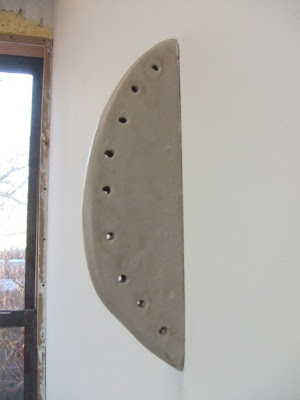
Lauren Carbone, Facemask After a Breakup, 2008. Installation view.

Facemask after a Breakup
Editing Public Pain: A Formula for Determining the Number of Photographs allowed for Public Display by a Facemasker after a Breakup
Start with longest amount of time Facemasker has ever been in a relationship
EX: 730 days, 104 weeks, 24 months, 2 yrs.
Next determine most pragmatic unit for measuring a Heterosexual-love relationship - The week! (Remember to insert explanation of why a week is the most pragmatic unit for measuring a heterosexual-love relationship, as apposed to a day, month or year)
Establish first numbered unit using most pragmatic unit (wk) for measuring a heterosexual-love relationship and subtract from total number of days in 2 year period to get the new total of days in a two-year period
Ex: 1. 7 days/1 wk = 730 days - 7 days/1week = 723 days
Increase previous numbered unit (Ex: 1. 7 days/1wk) to create next numbered unit by 7 days/ 1 week
Ex: 2. 14 days/2 weeks
Subtract another 7 days/ 1 week from the new total of days in a two-year period
Ex: 2. 14 days/2 weeks = 723 days -7 days = 709 days
Repeat until total number of units in two-year period is 0
Reaching 0: Establishing Tiers
When increasing previous numbered unit by 7 day/ 1 week becomes greater than the new total of days in a two-year period
Ex: 13. 91 days/13 wks/ 3 months & 1wk) = 93 days.
The next numbered unit cannot be increases by 7 days/ 1 week because the new total of days will equal 98 days, which is greater than the last new total of days, 93.
When this occurs, begin with 1 week and add 1 day. Increase week by 1 day and subtract from the new total of days in a two-year period. Repeat.
All numbered units falling above the point when increasing previous numbered unit by 7 days/ 1 week becomes greater than the new total of days in a two-year period constitute Tier 1.
All numbered units falling bellow this point constitute Tier 2.
When increasing previous numbered unit by 1 day is greater then 2 weeks
EX: 20. 15 days (2wk & 1day) = 15
Since the most pragmatic unit for measuring a Heterosexual-love relationship is 7 days / 1 week, begin with 6 days and subtract from the new total number of days.
Repeat, decreasing the previous numbed unit by 1 and subtract from the new total of days in a two-year period.
All numbered units falling bellow the point when increasing previous numbered units by 1 day is greater then 2 weeks constitute Tier 3.
Applying the Formula:
Application A. (Note: Color coding applies to Application B.)
730 days/ 104 weeks/ 24 months/ 2 yrs.
Numbered Units New Total Number of Days
1. 7 days (1 wk) = 723 days
2. 14 days (2 wk) = 709
3. 21 days (3wks) = 688
4. 28 days (4wk – 1 month) = 660
5. 35 days (5 wk – 1 month & 1wk) = 625
6. 42 days (6wk – 1 month & 2wk) = 583
7. 49 days (7wk – 1 month & 3wk) = 534
8. 56 days (8wk – 2 month) = 478
9. 63 days (9wk – 2 month & 1 wk) = 415
10. 70 days (10 wk – 2 month & 2 wk) = 345
11. 77 days (11wk – 2 month & 3wk) = 268
12. 84 days (12wk – 3 month) = 184
13. 91 days (13wk – 3 month & 1wk) = 93
________________________________________Tier 1______
14. 8 days (1wk & 1day) = 85
15. 9 days (1wk & 2days) = 76
16. 10 days (1wk & 3days) = 66
17. 11days (1wk & 4days) = 55
18. 12 days (1wk & 5days) = 43
19. 13 days (1wk & 6 days) = 30
20. 15 days (2wk & 1day) = 15
_________________________________________Tier 2_____
21. 6 days = 9
22. 5 days = 4
23. 4 days = 0
_________________________________________Tier 3____
Combining Numbered Units in Two Year Period to find the Number of Units that will equate the number of photographs for Facemask After a Breakup:
Finding combination of numbered units, physically faithful and combination of numbered units, psychologically faithful, will leave the Non-Combinable numbered units.
The Non- combinable numbered units are equal to the Actual Total Number of Days heterosexual-love relationship should have occurred and Jersey Number of Facemasker's ex.
The total of Numbered Units from each Combination of Numbered Units and Non-Combinable Numbered Units is the number of photographs for Facemask After a Breakup.
Directions:
1) Define and use the Total number of days Facemasker was physically faithful in heterosexual-love relationship. (Insert definition of faithful)
(Ex: Facemasker reports being physically faithful for 1 year = 365 days/ 52 wks/ 12 months).
Next, starting with bottom numbered unit of Tier 1 and moving upward, add numbered units to equate total number of days, weeks, months, years Facemasker was physically faithful in heterosexual-love relationship
(Ex: 1) Combine 13, 12, 11, 10, 5 & 14= 365 days/ 52 wks/ 12 months/ 1 year
When numbered units from Tier 1 can no longer be plugged in to equate total number of days Facemasker was physically faithful in heterosexual-love relationship, start with bottom numbered unit of Tier 2, moving upward. When numbered units from Tier 2 can no longer be plugged in to equate total number of days Facemasker was physically faithful in heterosexual-love relationship, start with bottom numbered unit of Tier 3, moving upward.
2) Find total days facemasker was psychologically faithful in Hetero-love relationship by applying the same formula as above, however, dividing the total number of weeks facemasker was physically faithful in heterosexual-love relationship in half.
(Ex: 1) Combine 13, 12, 11, 10, 5 & 14= 365 days/ 52 wks/ 12 months/ 1 year
To find next numbered unit, take 365 days divided by 2 = 182 days/ 26wks/ 6 months/ .5 year
(EX: 2) Combine 9, 8, 7 & 2 = 182 days/ 26 wks/ 6 months/ .5 year
Do this until the number of days Facemasker was psychologically faithful in heterosexual-love relationship no longer equals a whole day.
(EX: 5) Combine 20, 19 & 2 = 23 days/ .3.25 wks/ .75 months/ .0625 year
23 days divided by 2 = 11.5……STOP
The remaining days from numbered units in two-year period will equate the actual total number of days heterosexual-love relationship should have occurred, as well as the jersey number of facemasker's ex.
Applying the Formula:
Application B (Refer to Application A color-coding via Application B)
Actual number of units Facemasker was faithful in Hetero-love relationship = 52wks; 365 days:
Numbered Units
1) Combine 13, 12, 11, 10, 5 & 14= 365 days/ 52 wks/ 12 months/ 1 year
____________365 days/ 52 wks/ 12 months/ 1 year physically faithful.
2) Combine 9, 8, 7 & 2 = 182 days/ 26 wks/ 6 months/ .5 year
3) Combine 6, 4 & 3 = 91 days/ 13 wks/ 3 months/ .25 year
4) Combine 1, 20, 19, & 17= 46 days/ 6.5 wks/ 1.5 months/ .125 year
5) Combine 20, 19 & 2 = 23 days/ .3.25 wks/ .75 months/ .0625 year
____________346 days/ 49 wks/ 11 months/ 0.947316606 year psychologically faithful
Remaining days from numbered units in two-year period:
6) 10 days
7) 9 days
8) 6 days
9) 5 days
10) 4 days
___________34 days/ 4.85714286 wks/ 1.11706698 months/ 0.093088915 year
Actual Total Number of Days Heterosexual-Love Relationship should have Occurred and Jersey Number of Facemasker's Ex:
34 = 34 days/ 4.85714286 wks/ 1.11706698 months/ 0.093088915 year
Total Number of Photographs allowed for Public Display by Facemasker after a Breakup to Express Pain through Separation = Total Number of Numbered Units in Application B:
10


Editing Public Pain: A Formula for Determining the Number of Photographs allowed for Public Display by a Facemasker after a Breakup
Start with longest amount of time Facemasker has ever been in a relationship
EX: 730 days, 104 weeks, 24 months, 2 yrs.
Next determine most pragmatic unit for measuring a Heterosexual-love relationship - The week! (Remember to insert explanation of why a week is the most pragmatic unit for measuring a heterosexual-love relationship, as apposed to a day, month or year)
Establish first numbered unit using most pragmatic unit (wk) for measuring a heterosexual-love relationship and subtract from total number of days in 2 year period to get the new total of days in a two-year period
Ex: 1. 7 days/1 wk = 730 days - 7 days/1week = 723 days
Increase previous numbered unit (Ex: 1. 7 days/1wk) to create next numbered unit by 7 days/ 1 week
Ex: 2. 14 days/2 weeks
Subtract another 7 days/ 1 week from the new total of days in a two-year period
Ex: 2. 14 days/2 weeks = 723 days -7 days = 709 days
Repeat until total number of units in two-year period is 0
Reaching 0: Establishing Tiers
When increasing previous numbered unit by 7 day/ 1 week becomes greater than the new total of days in a two-year period
Ex: 13. 91 days/13 wks/ 3 months & 1wk) = 93 days.
The next numbered unit cannot be increases by 7 days/ 1 week because the new total of days will equal 98 days, which is greater than the last new total of days, 93.
When this occurs, begin with 1 week and add 1 day. Increase week by 1 day and subtract from the new total of days in a two-year period. Repeat.
All numbered units falling above the point when increasing previous numbered unit by 7 days/ 1 week becomes greater than the new total of days in a two-year period constitute Tier 1.
All numbered units falling bellow this point constitute Tier 2.
When increasing previous numbered unit by 1 day is greater then 2 weeks
EX: 20. 15 days (2wk & 1day) = 15
Since the most pragmatic unit for measuring a Heterosexual-love relationship is 7 days / 1 week, begin with 6 days and subtract from the new total number of days.
Repeat, decreasing the previous numbed unit by 1 and subtract from the new total of days in a two-year period.
All numbered units falling bellow the point when increasing previous numbered units by 1 day is greater then 2 weeks constitute Tier 3.
Applying the Formula:
Application A. (Note: Color coding applies to Application B.)
730 days/ 104 weeks/ 24 months/ 2 yrs.
Numbered Units New Total Number of Days
1. 7 days (1 wk) = 723 days
2. 14 days (2 wk) = 709
3. 21 days (3wks) = 688
4. 28 days (4wk – 1 month) = 660
5. 35 days (5 wk – 1 month & 1wk) = 625
6. 42 days (6wk – 1 month & 2wk) = 583
7. 49 days (7wk – 1 month & 3wk) = 534
8. 56 days (8wk – 2 month) = 478
9. 63 days (9wk – 2 month & 1 wk) = 415
10. 70 days (10 wk – 2 month & 2 wk) = 345
11. 77 days (11wk – 2 month & 3wk) = 268
12. 84 days (12wk – 3 month) = 184
13. 91 days (13wk – 3 month & 1wk) = 93
________________________________________Tier 1______
14. 8 days (1wk & 1day) = 85
15. 9 days (1wk & 2days) = 76
16. 10 days (1wk & 3days) = 66
17. 11days (1wk & 4days) = 55
18. 12 days (1wk & 5days) = 43
19. 13 days (1wk & 6 days) = 30
20. 15 days (2wk & 1day) = 15
_________________________________________Tier 2_____
21. 6 days = 9
22. 5 days = 4
23. 4 days = 0
_________________________________________Tier 3____
Combining Numbered Units in Two Year Period to find the Number of Units that will equate the number of photographs for Facemask After a Breakup:
Finding combination of numbered units, physically faithful and combination of numbered units, psychologically faithful, will leave the Non-Combinable numbered units.
The Non- combinable numbered units are equal to the Actual Total Number of Days heterosexual-love relationship should have occurred and Jersey Number of Facemasker's ex.
The total of Numbered Units from each Combination of Numbered Units and Non-Combinable Numbered Units is the number of photographs for Facemask After a Breakup.
Directions:
1) Define and use the Total number of days Facemasker was physically faithful in heterosexual-love relationship. (Insert definition of faithful)
(Ex: Facemasker reports being physically faithful for 1 year = 365 days/ 52 wks/ 12 months).
Next, starting with bottom numbered unit of Tier 1 and moving upward, add numbered units to equate total number of days, weeks, months, years Facemasker was physically faithful in heterosexual-love relationship
(Ex: 1) Combine 13, 12, 11, 10, 5 & 14= 365 days/ 52 wks/ 12 months/ 1 year
When numbered units from Tier 1 can no longer be plugged in to equate total number of days Facemasker was physically faithful in heterosexual-love relationship, start with bottom numbered unit of Tier 2, moving upward. When numbered units from Tier 2 can no longer be plugged in to equate total number of days Facemasker was physically faithful in heterosexual-love relationship, start with bottom numbered unit of Tier 3, moving upward.
2) Find total days facemasker was psychologically faithful in Hetero-love relationship by applying the same formula as above, however, dividing the total number of weeks facemasker was physically faithful in heterosexual-love relationship in half.
(Ex: 1) Combine 13, 12, 11, 10, 5 & 14= 365 days/ 52 wks/ 12 months/ 1 year
To find next numbered unit, take 365 days divided by 2 = 182 days/ 26wks/ 6 months/ .5 year
(EX: 2) Combine 9, 8, 7 & 2 = 182 days/ 26 wks/ 6 months/ .5 year
Do this until the number of days Facemasker was psychologically faithful in heterosexual-love relationship no longer equals a whole day.
(EX: 5) Combine 20, 19 & 2 = 23 days/ .3.25 wks/ .75 months/ .0625 year
23 days divided by 2 = 11.5……STOP
The remaining days from numbered units in two-year period will equate the actual total number of days heterosexual-love relationship should have occurred, as well as the jersey number of facemasker's ex.
Applying the Formula:
Application B (Refer to Application A color-coding via Application B)
Actual number of units Facemasker was faithful in Hetero-love relationship = 52wks; 365 days:
Numbered Units
1) Combine 13, 12, 11, 10, 5 & 14= 365 days/ 52 wks/ 12 months/ 1 year
____________365 days/ 52 wks/ 12 months/ 1 year physically faithful.
2) Combine 9, 8, 7 & 2 = 182 days/ 26 wks/ 6 months/ .5 year
3) Combine 6, 4 & 3 = 91 days/ 13 wks/ 3 months/ .25 year
4) Combine 1, 20, 19, & 17= 46 days/ 6.5 wks/ 1.5 months/ .125 year
5) Combine 20, 19 & 2 = 23 days/ .3.25 wks/ .75 months/ .0625 year
____________346 days/ 49 wks/ 11 months/ 0.947316606 year psychologically faithful
Remaining days from numbered units in two-year period:
6) 10 days
7) 9 days
8) 6 days
9) 5 days
10) 4 days
___________34 days/ 4.85714286 wks/ 1.11706698 months/ 0.093088915 year
Actual Total Number of Days Heterosexual-Love Relationship should have Occurred and Jersey Number of Facemasker's Ex:
34 = 34 days/ 4.85714286 wks/ 1.11706698 months/ 0.093088915 year
Total Number of Photographs allowed for Public Display by Facemasker after a Breakup to Express Pain through Separation = Total Number of Numbered Units in Application B:
10


Lauren Carbone is from Southern California. She has been a competitive figure skater, a Sorority sister, an Art teacher, an NFL cheerleader, a wood shop technician, and an assistant to the director of Trade at the New York Mercantile Exchange. Lauren earned her M.F.A. in Sculpture and New Media at Tyler School of Art, Temple University in Philadelphia, and also studied at the Rome campus. She has a B.A. in Art Studio from the University of California, Davis.
Lauren will be in a group show at the Collision Machine in Brooklyn on April 26th. Recent solo exhibitions include Jillian Baba, Jillian Baba Gallery in Brooklyn, NY and Success, The Barber Shop Gallery in Philadelphia, PA. She currently lives at Envirolution headquarters on the Lower East Side and dreams of one day designing and producing her own lingerie line from recycled clothing.
Lauren will be in a group show at the Collision Machine in Brooklyn on April 26th. Recent solo exhibitions include Jillian Baba, Jillian Baba Gallery in Brooklyn, NY and Success, The Barber Shop Gallery in Philadelphia, PA. She currently lives at Envirolution headquarters on the Lower East Side and dreams of one day designing and producing her own lingerie line from recycled clothing.
The Laundromat is grateful to Alex Gamboa, of Envirolution for their support of this exhibition. To find out more about Envirolution's efforts to promote environmental sustainability visit: www.envirolution.org




 Posts
Posts